Performance Tests
Performance tests are a key part of longevity diagnostics — they show how fit your body really is.
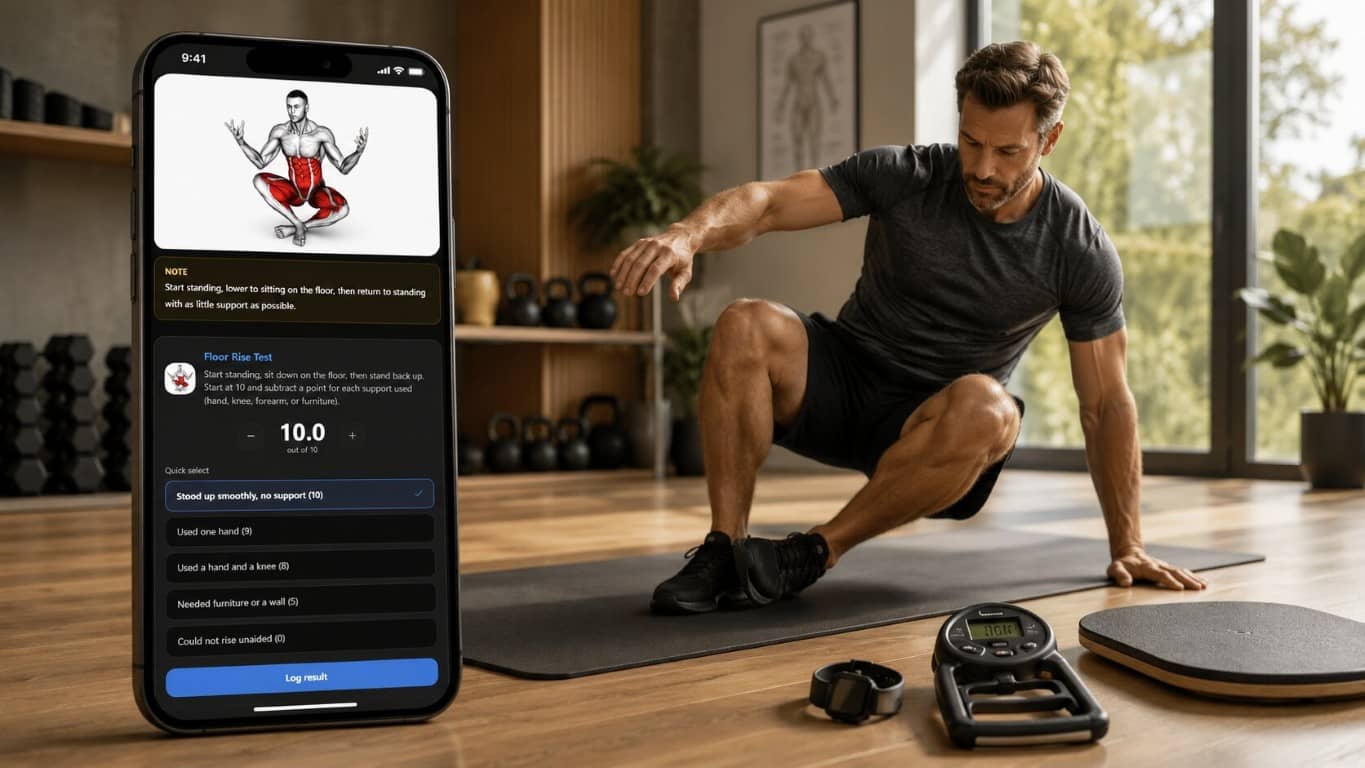
Table of contents
What performance tests are and why they matter
Performance tests show how fit you really are — your strength, endurance, speed, balance, and power. They give practical information about physical fitness that even advanced epigenetic clocks estimating biological age do not provide.
If you cannot do a single pull-up, focus on the basics of fitness first. Biological age, advanced therapies, and complex lab results can wait.
In the Longevity Protocols app you get a set of performance tests you can run regularly to track progress. Each test includes step-by-step instructions for correct form.
Types of tests and their exercises
There are three kinds of tests:
- Functional Fitness Check — how well your body handles basic movement tasks that need strength, mobility, and coordination.
- Strength & Power Benchmark — how much muscle force you can produce and how quickly you can generate power.
- Lab CPET — a lab test of cardiorespiratory fitness that measures VO₂max precisely.
Functional Fitness Check
Recommended frequency: every 4 weeks.
Functional fitness is your ability to do everyday tasks — bending down, getting up from the floor, holding balance, or carrying heavy objects.
This set of tests measures grip strength, balance, mobility, muscular endurance, and aerobic fitness. Regular scores help you track change and spot areas to work on.
Keeping these abilities matters more with age. They support independence, lower fall risk, and make daily life easier.
What you need for these tests
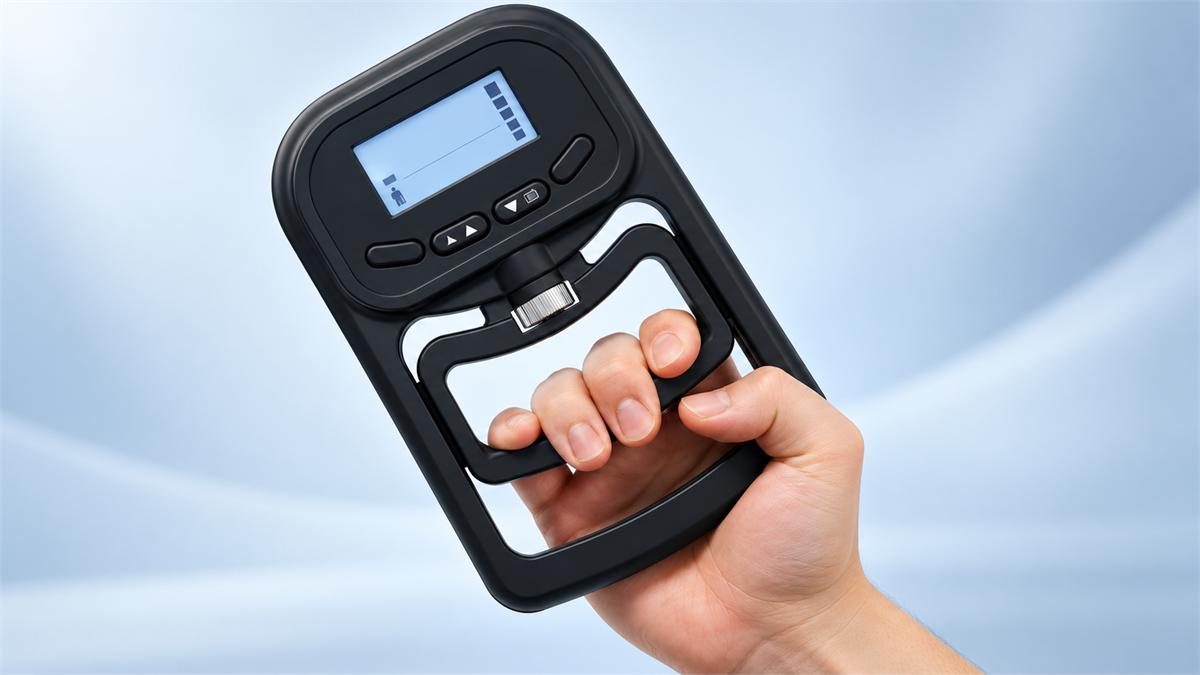
Hand dynamometer — a device that measures grip strength. It is relatively inexpensive, easy to use, and gives an objective score you can compare over time. Search online for “hand dynamometer” or “grip strength meter”.
- Pull-up bar — for the hang-time test.
- Treadmill or measured running route — for the 12-minute Cooper Test.
- Tape measure or ruler — for Sit-and-Reach range.
- Stopwatch — for timed tests.
Functional fitness tests
-
Handgrip Strength (Left). Max squeeze of the left hand with a dynamometer. Grip strength is a simple, well-studied marker of overall muscle fitness. In population studies, lower scores link to more functional limits and earlier death.
-
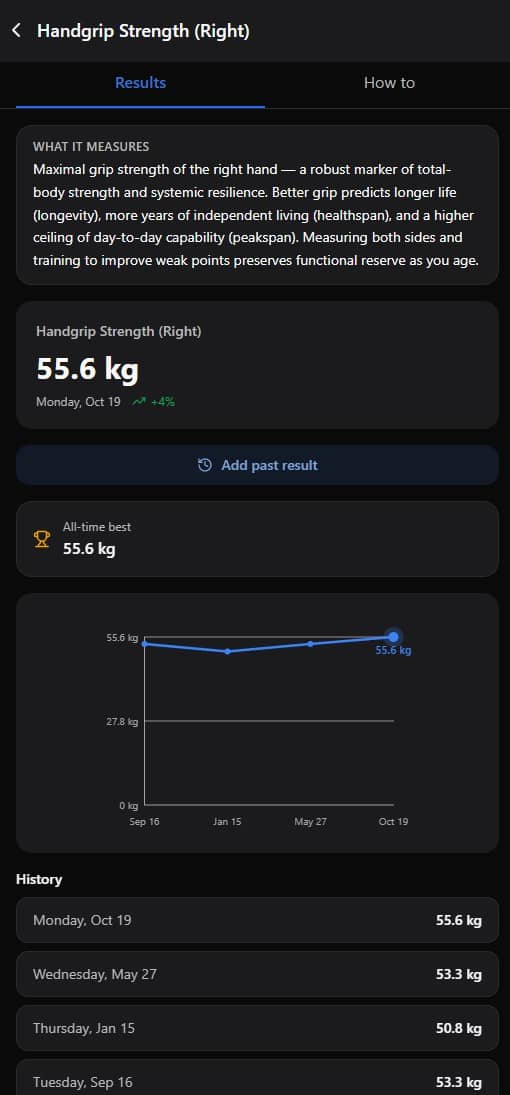
Handgrip Strength (Right). Max squeeze of the right hand. Separate scores for each hand let you see side differences and track progress on both sides.
-
Single-Leg Stand, Eyes Open (Left). Balance test: stand on the left leg as long as you can. Balance is a key part of functional fitness; when it declines, fall risk rises. If you hold longer than 2 minutes, move to the harder eyes-closed version.
-
Single-Leg Stand, Eyes Open (Right). The same test on the right leg. Comparing both sides highlights gaps in stability. After 2 minutes, increase difficulty with eyes closed.
-
Single-Leg Stand, Eyes Closed (Left). Harder balance test without vision, so you rely more on body awareness and the vestibular system. Use it after you can do the eyes-open version, in a safe spot with something to hold if needed.
-
Single-Leg Stand, Eyes Closed (Right). The same test on the right leg. Shows stability without vision and lets you compare both sides.
-
Handstand Hold. Advanced test of shoulder strength, trunk stability, balance, and full-body control. Extra challenge for highly fit users. Not required for a basic functional fitness check — only for people who are ready for it.
-
Sit-and-Reach. Forward bend range, driven largely by hamstring flexibility and lower-back mobility. Tracks mobility, which supports everyday movement.
-
Floor Rise Test (0–10). Sit on the floor and stand up with as little extra support as possible. Combines strength, mobility, balance, and coordination. The 0–10 score tracks the fitness needed for independent movement and daily tasks.
-
Push-ups (Max Reps). Upper-body strength and muscular endurance. Correct push-up count shows how chest, shoulders, arms, and trunk handle repeated effort. Regular scores track training progress.
-
Bar Hang (Time). Hang from a bar as long as you can. Unlike a dynamometer, which measures peak squeeze, the hang mainly tests grip endurance and holding your own body weight.
-
Forearm Plank Hold (Time). Endurance of the muscles that stabilize the trunk. Hold a correct plank as long as you can. Tracks endurance in the abs, back, and other stabilizers.
-
Cooper Test (12 min). Cardiorespiratory fitness: cover as much distance as you can in 12 minutes. Estimates aerobic fitness and can approximate VO₂max from distance. It does not replace a lab CPET, but it is a simple way to track endurance regularly.
Tip: To keep scores comparable, retest under similar conditions with the same technique and scoring rules. You do not have to do every test on the same day — especially the all-out efforts.
Strength & Power Benchmark
Recommended frequency: every 3 months.
Muscle strength and power are both important for fitness. Strength is how much force your muscles can produce. Power is how quickly they can produce that force.
Both decline with age, and power often falls faster than max strength. That shows up in daily life — standing from a chair, climbing stairs, or catching yourself after a stumble.
This set of tests measures strength and power across muscle groups, flags weaker areas, and tracks long-term training progress.
What you need for these tests
- Hand dynamometer — for max grip strength.
- Pull-up bar — for pull-ups and hanging leg raises.
- Barbell and plates — for bench press and deadlift.
- Training bench — for bench press.
- Tape measure — for standing broad jump distance.
Some tests take high effort and solid technique. For barbell lifts especially, use an experienced coach for form and safety.
Do not attempt max-strength tests without enough experience. If needed, use safer variations or estimate max strength from a weight you can lift for several reps.
Strength and power tests
-
Handgrip Strength (Left). Max left-hand squeeze with a dynamometer. A simple marker of overall muscle fitness. Including it lets you compare grip with the other strength tests and track change over time.
-
Handgrip Strength (Right). The same for the right hand. Separate scores show side-to-side differences.
-
Standing Broad Jump. Lower-body explosive power: jump as far as you can from a standing start with both feet. Distance reflects how quickly the legs can produce force. That power matters for moving well, standing up dynamically, and reacting to a sudden loss of balance.
-
Pull-ups (Max Reps). Relative upper-body strength and muscular endurance: as many correct pull-ups as you can. Mainly back, arms, and grip. Tracks your ability to lift your own body weight.
-
Bench Press. Strength of the chest, shoulders, and triceps pushing an external load. Unlike push-ups, you can record the exact weight and track max strength more precisely.
-
Deadlift. Strength through the glutes, hamstrings, back, and grip. Tests lifting a load from the floor while staying stable. That movement maps to many daily lifting and carrying tasks.
-
Hanging Leg Raise (Max Reps). Strength and endurance of the abs and hip flexors, while you also stabilize the trunk and hold the bar. Correct reps show control and endurance in a harder position than floor core work.
Measure bench press and deadlift with a 5RM
For bench press and deadlift we recommend a 5RM (5 Repetition Maximum) — the heaviest weight you can lift for 5 correct reps — instead of a one-rep max (1RM).
A 5RM still tracks muscle strength reliably while limiting work with extreme loads. Absolute weight is lower, and it is usually more practical if you train for long-term health rather than strength records.
Remember: a 5RM is still an all-out effort. Do it after a proper warm-up, with solid technique and spotting. Stop if you cannot keep correct form.
Tip: Do max strength and power tests after a proper warm-up, when you are well rested. Keep the same technique, range of motion, and measurement method so scores stay comparable. Avoid stacking every max test back to back — fatigue hurts both results and safety.
Lab CPET
Recommended frequency: once every 12 months.
CPET (Cardiopulmonary Exercise Testing) is a lab test of cardiorespiratory fitness. It shows how your body responds as effort increases step by step.
The test analyzes oxygen intake, carbon dioxide output, lung ventilation, and how the heart and circulation respond. One of the key numbers is VO₂max or VO₂peak — your aerobic capacity.
Cardiorespiratory fitness is one of the best-studied markers of health and long-term outlook. Higher fitness links, in population studies, to lower risk of cardiovascular disease and earlier death.
Unlike field fitness tests such as the Cooper Test, CPET measures oxygen use during exercise directly.
You take the test at a specialized clinic. In the Longevity Protocols app you can save the score and track it over the years.
What you need for this test
CPET is done in an exercise diagnostics lab, sports medicine clinic, or similarly equipped center.
To find a location near you, search for “CPET”, “cardiopulmonary exercise testing”, or “VO₂max test”.
The test usually runs on a treadmill or cycle ergometer. You breathe through a mask that analyzes gas exchange during effort.
You will get prep instructions beforehand. Avoid hard training right before the test so fatigue does not lower your score.
Measured parameters
- VO₂max / VO₂peak (CPET). Oxygen your body can use during hard exercise, in ml per kg of body weight per minute. VO₂max is the true maximum oxygen uptake. VO₂peak is the highest value recorded in that session when a full physiological maximum was not confirmed. Higher scores usually mean better aerobic fitness. Regular tests show the effect of endurance training and how fitness changes with age.
Tip: For comparable results, use a similar protocol, the same type of equipment, and similar conditions. Note whether the report lists VO₂max or VO₂peak, and keep the full lab reports.
Configure tests
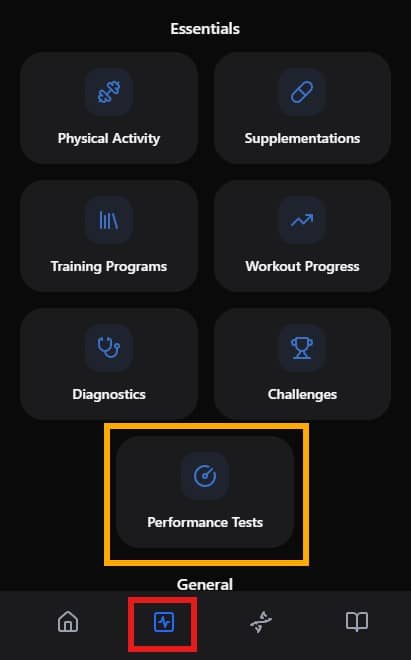
Tap the second icon in the bottom navigation, then Performance Tests.
Choose Configure tests.
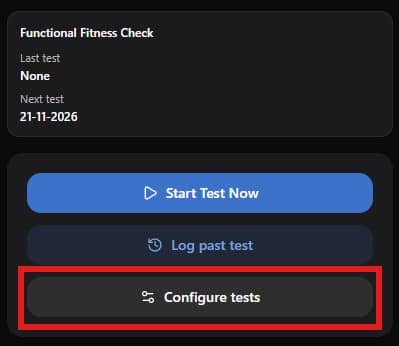
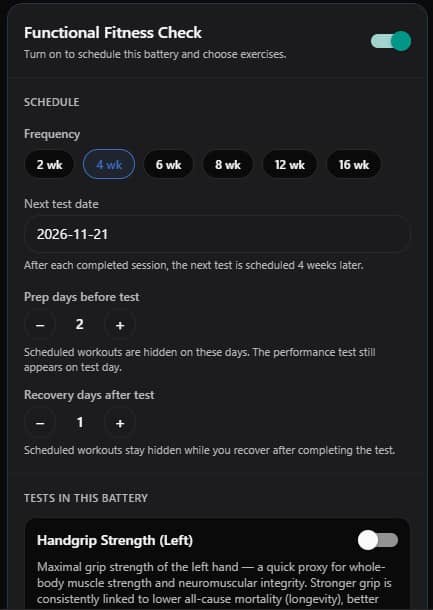
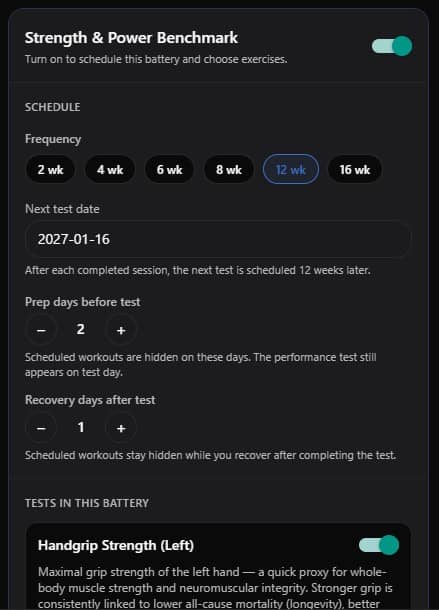
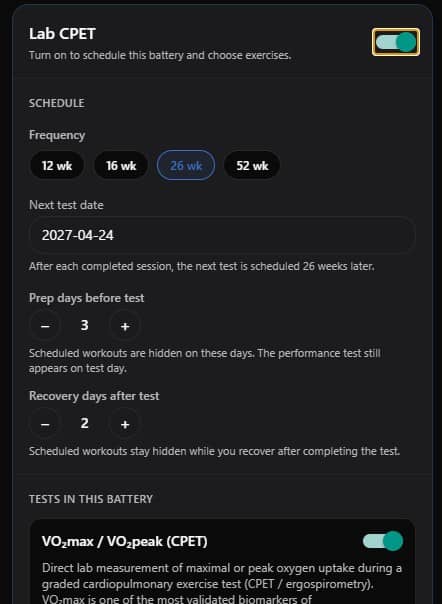
For each of the three tests you set how often to run it, the next test date, and prep and recovery days.
Frequency controls how often the test returns in the app as a reminder. Keep the defaults:
- Functional Fitness Check — every 4 weeks
- Strength & Power Benchmark — every 12 weeks
- Lab CPET — every 12 months (52 wk on screen)
Next test date is your next measurement.
Prep days before test and Recovery days after test are the days before and after the test. On those days the app hides scheduled workouts. On test day, the test itself stays on the list.
There are three kinds of tests. Turn each one on or off with the switch at the top, set its frequency separately, and choose which exercises it includes. Keep the suggested exercise set.
Functional Fitness Check
Strength & Power Benchmark
Lab CPET
When the tests are set, tap Save.

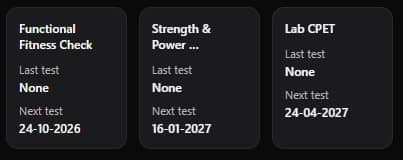
After saving, a panel shows the tests you just set. Each one lists the last test date and the next date.
Last test is the previous measurement. At first it shows None. Next test is the upcoming date.
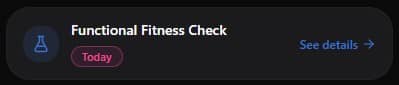
When the date approaches, Home — the main app screen — shows a reminder. The Today badge means the test is due today. See details opens that test.
Run a test
- Tap Start Test Now.
- Choose which test to run.
- You see the exercise list set for that test. Tap Start.
- After the warm-up, tap Start again. Do each exercise as shown on screen and enter the score for every exercise.
Read and review results
After a test, scores appear in the Performance Tests list. Each exercise shows the latest score and the change versus the previous test.
A green up arrow and a plus mean improvement. A red down arrow and a minus mean a drop. 0% means the score is unchanged.
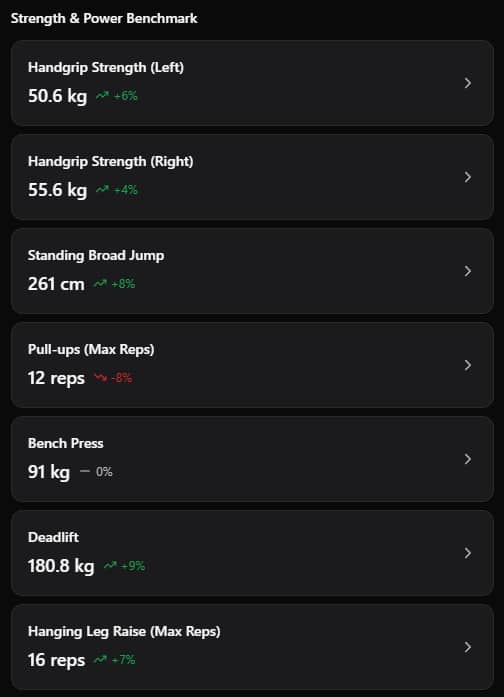
Tap an exercise for details. The Results tab shows what the exercise measures, the latest score with date, change versus the previous test, your record, a chart, and history.
All-time best is your best score so far. History lists earlier measurements by date. The chart shows how the score changed over time. Add past result adds an older score to that history. The How to tab shows how to perform the exercise.