Creatine plus velocity-intent training. A new lead in fighting age-related decline in strength and cognitive function
A study in older adults suggests that resistance training performed with the intent to move quickly, especially when combined with creatine, may influence not only strength but also markers of neuroplasticity, oxidative stress, inflammation, physical function and quality of life.
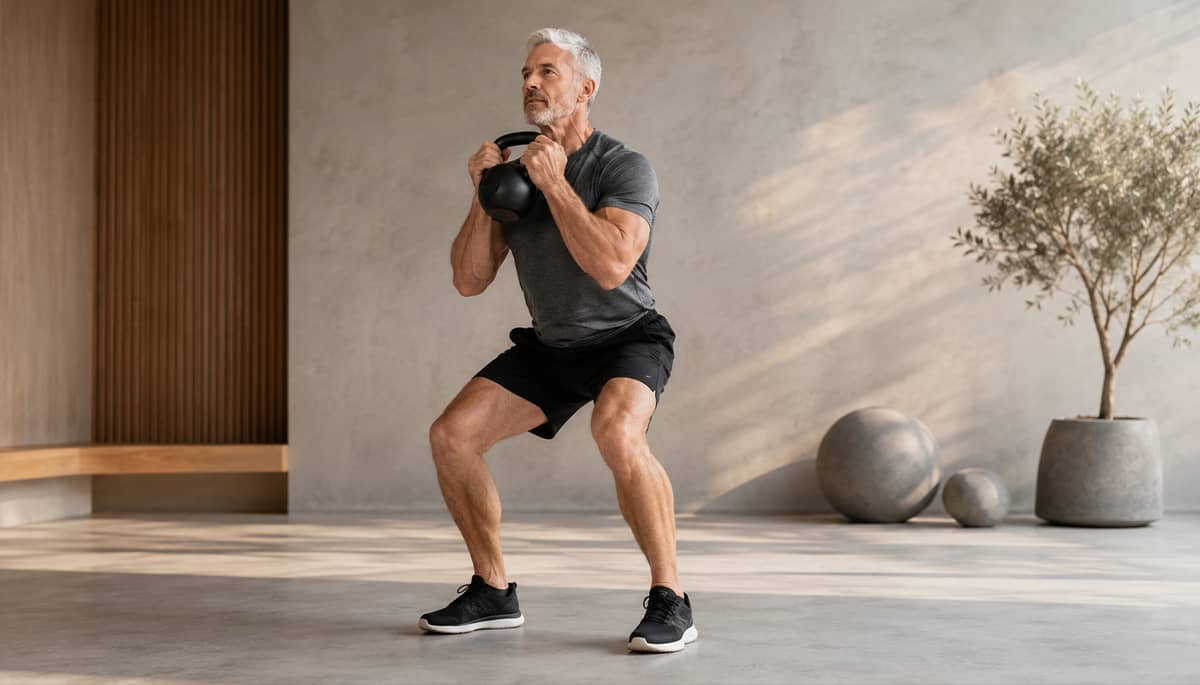
Table of contents
Why this study is interesting
Age-related strength decline is not only about muscles getting smaller. Just as important is the decline in the ability to generate force quickly, along with poorer coordination, inflammation, oxidative stress and weaker communication between the nervous system and muscles. That is why researchers are increasingly looking not only at traditional strength training, but also at training in which the person tries to perform the lifting phase as dynamically as safely possible.
This is the context of a study published in Experimental Gerontology. The researchers examined how moderate- to high-load resistance training performed with a high-velocity movement intention worked in older adults, and whether combining it with creatine supplementation produced additional effects.
This matters because creatine is often described very narrowly — as a supplement for “strength” or “muscle mass.” In aging, however, the context is broader. The real question is not only whether a muscle becomes bigger, but whether a person can preserve functional capacity, independence, quality of life and possibly biological processes related to the brain and neuroplasticity.
Study details
The details below include only information available from the publication metadata and public summary of the study. This section should not be treated as a full reconstruction of the protocol, because the full article was not available in open preview.
- Publication title: “Effects of high-load, velocity-intentional variable resistance training combined with creatine supplementation on neuroplasticity, oxidative stress, inflammation, physical function, cognitive performance and quality of life in older adults: A randomized, double-blind, placebo-controlled trial”.
- Authors: J. Fernandez-Garrido and colleagues.
- Year of publication: 2026.
- Journal: Experimental Gerontology.
- Study type: randomized, double-blind, placebo-controlled interventional trial.
- Population: community-dwelling older adults; the public summary reported an average age of approximately 68 years.
- Intervention duration: 16 weeks.
- Intervention: resistance training with a high-velocity movement intention, performed using methods such as resistance bands or aquatic training, with comparison between creatine and non-creatine conditions.
- Main assessed domains: neuroplasticity, oxidative stress, inflammation, physical function, cognitive performance and quality of life.
- Article identifier: Experimental Gerontology, article 113122.
- Publication link: ScienceDirect.
The design is important because the study did not ask only the classic question: “Does creatine increase strength?”. Instead, the authors assessed a broader set of markers that may better reflect real-world biological aging.
What the results suggest
The results suggest that velocity-intent resistance training itself was beneficial, while creatine may have further amplified some effects of the intervention. What makes the study especially interesting is that the changes were not limited to physical performance, but also involved markers related to the nervous system, oxidative stress and inflammation.
The main observations can be summarized in several areas:
- Neuroplasticity may have improved, as training groups showed an increase in BDNF, a protein involved in neuronal survival, growth and adaptation. This does not automatically mean “brain rejuvenation,” but it is an interesting biological signal.
- Oxidative stress shifted in a favorable direction, as training was associated with improved markers of oxidative balance. Public summaries mention, among others, reduced F2-isoprostanes and increased glutathione peroxidase activity.
- Inflammatory markers also improved, especially in the training groups. The study assessed markers such as IL-6 and TNF-α, which are often discussed in the context of chronic low-grade inflammation associated with aging.
- Physical function and strength increased, which is the most practical part of the study. In older adults, better strength, balance, walking ability and rapid force production can have direct relevance for daily independence.
- The cognitive effect of creatine was less clear, as public summaries suggest that training improved cognitive test outcomes, but creatine did not necessarily add a clear benefit beyond training alone.
This distinction matters. The study does not show that creatine is a magic supplement for the brain. It suggests rather that, when combined with well-designed movement, it may be one element of a broader strategy to support function in later life.
What this means in practice
The most practical conclusion concerns the training approach itself. In older age, it is not enough to think only in terms of “lifting weights.” The ability to produce force quickly, safely and under control also matters. This quality can be crucial for standing up from a chair, recovering balance after a stumble or reacting quickly to a changing situation.
In practice, the study supports several ways of thinking:
- Strength training in older adults should include not only slow, controlled repetitions, but also an element of velocity intent. This does not mean chaotic movement. It means trying to perform the concentric phase dynamically while maintaining technique and safety.
- Creatine may make more sense as an addition to training than as a standalone intervention. Its potential is best interpreted in the context of physical activity, recovery and the muscle’s ability to perform work.
- The greatest value may lie in function, not muscle mass alone. For older adults, what matters most is whether it becomes easier to stand up, walk, maintain balance and preserve independence — not only whether muscle mass changes on paper.
- Aquatic training and resistance-band training may be realistic tools for older adults. This is important because not every older person will be ready or willing to train in a conventional gym with machines or free weights.
From a longevity perspective, this direction is especially interesting because it connects several layers: muscle, brain, inflammation, oxidative stress and quality of life. That is much closer to real aging than looking at one isolated marker.
Limitations and cautious interpretation
The study is interesting, but it should not be read as definitive proof that every older adult should automatically take creatine. Training interventions depend heavily on context: age, comorbidities, baseline fitness, diet, medication use, kidney function and the quality of exercise supervision.
The key limitations and caveats are:
- This was an interventional study with a limited duration. Sixteen weeks is enough to observe adaptations, but it does not answer how durable the effects are after the program ends.
- Not all creatine effects were equally strong. Public summaries suggest that creatine may have enhanced some training effects, but it did not clearly add benefits in every domain, especially cognitive performance.
- The results may depend on the training modality. Resistance-band training, aquatic training and traditional strength training are not biomechanically identical, so the findings should not automatically be transferred to every exercise program.
- Safety requires individualization. Older adults, especially those with kidney disease, polypharmacy or cardiovascular issues, should consult supplementation and more intensive training with a physician or qualified specialist.
- A full appraisal requires access to the complete article. Details such as participant characteristics, exact dosing, adherence and statistical analysis are essential for evaluating the strength of the conclusions.
The most reasonable interpretation is therefore moderate: creatine and velocity-intent resistance training look promising as a combination, but the central intervention remains well-designed, regular and safe resistance training.
Sources
- Effects of high-load, velocity-intentional variable resistance training combined with creatine supplementation on neuroplasticity, oxidative stress, inflammation, physical function, cognitive performance and quality of life in older adults: A randomized, double-blind, placebo-controlled trial — ScienceDirect
- Creatine Shows Synergy With Exercise in Older Adults — Lifespan.io