The immune system may worsen skin damage after sun exposure
UVB radiation directly damages the skin, but new research suggests that part of the immune response may further amplify inflammation and cellular injury.
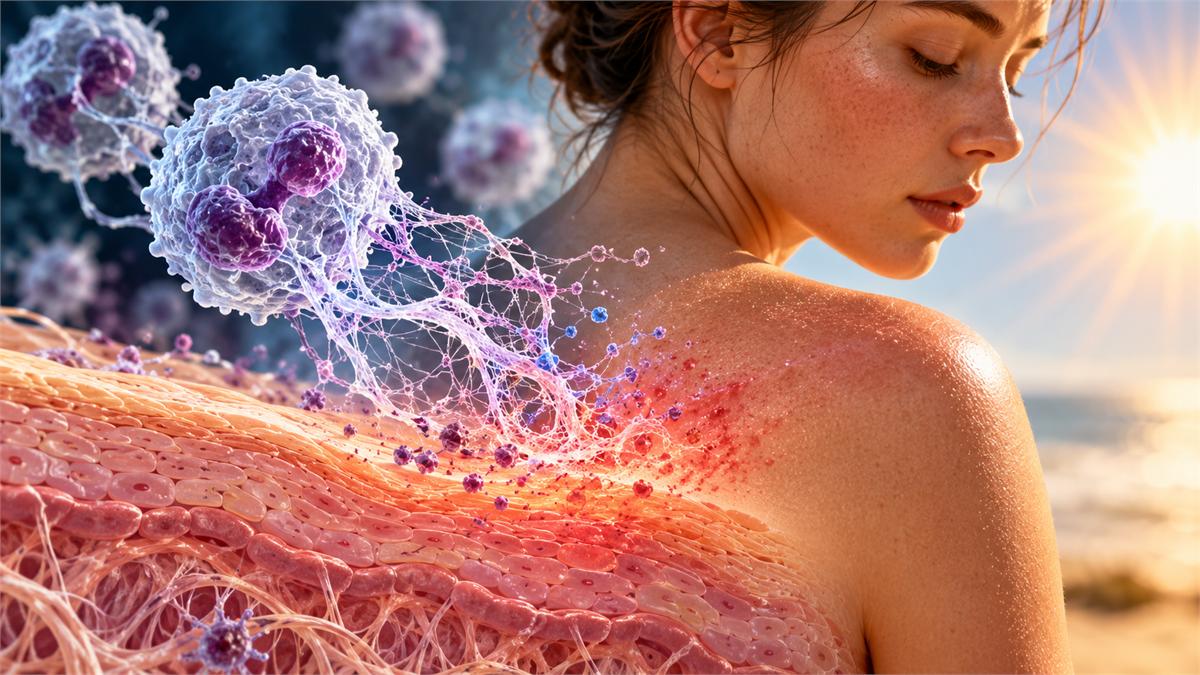
Table of contents
UVB radiation may trigger a second wave of damage
Ultraviolet B (UVB) radiation can directly damage skin cells, increase oxidative stress, and trigger inflammation. A new study published in Aging Cell suggests, however, that the process may not end there. The immune response to damaged skin may further amplify some of the harmful effects of UVB exposure.
At the center of this mechanism are neutrophils, immune cells that form part of the body’s first line of defense. They can produce neutrophil extracellular traps (NETs) — structures composed partly of DNA and proteins released by neutrophils.
NETs play an important role during infections because they can trap microorganisms. Problems may arise when a similar response occurs in tissue damage that is not caused by an infection.
The researchers observed several related findings:
-
NETs were more abundant in skin lesions associated with chronic light exposure, suggesting that this mechanism may also occur in human skin.
-
In mice, suppressing NET formation with the PAD4 inhibitor GSK484 reduced UVB-induced skin damage, inflammation, and cellular apoptosis.
-
In cultured human keratinocytes, exposure to NETs increased oxidative stress, inflammatory cytokine release, and cell death, while reducing cell viability.
-
The researchers also identified a potential molecular mechanism: NETs interacted with the CCDC25 receptor, subsequently activating the p-JNK/JNK signaling pathway, which belongs to the MAPK family.
The findings therefore suggest that some of the damage occurring after UVB exposure may result not only from radiation itself but also from the body’s secondary inflammatory response.
Study details
The study combined several experimental approaches: human skin samples, experiments in mice, and cultured skin cells. This makes it possible to examine the proposed mechanism at several biological levels, but it is not equivalent to a clinical trial testing a treatment in humans.
-
Publication title: Neutrophil Extracellular Traps Exacerbate UVB-Induced Photodamage in HaCaT Cells and Mouse Skin via CCDC25/MAPK Pathway.
-
Authors: Yang Zou, Junzhi Li, Yuting Peng, Rui Hu, Ruolin Li, and Aijun Chen.
-
Affiliation: Department of Dermatology, The First Affiliated Hospital of Chongqing Medical University, Chongqing, China.
-
Publication: Aging Cell, volume 25, issue 8, 2026.
-
First published: July 23, 2026.
-
DOI: 10.1111/acel.70640.
-
PMID: 42492479.
-
PMCID: PMC13395479.
-
Study type: experimental mechanistic study combining human tissue, an animal model, and in vitro experiments.
-
Human samples: the researchers analyzed affected skin from 10 patients with actinic keratosis or chronic actinic dermatitis and non-light-exposed skin samples from 5 healthy donors.
-
Animal model: male C57BL/6J mice were divided into groups of six animals. In the acute photodamage model, skin was exposed to UVB, while some animals received the PAD4 inhibitor GSK484 to reduce NET formation.
-
Cell model: the researchers used the human HaCaT keratinocyte cell line, exposing cells to NETs and assessing outcomes including cell viability, apoptosis, oxidative stress, and inflammatory cytokine release.
-
Main endpoint: the results indicated that NETs may aggravate photodamage through interaction with CCDC25 and activation of the p-JNK/JNK pathway. Inhibiting NET formation or disrupting this mechanism reduced some of the observed damage in experimental models.
-
Funding: the publication reports support from the Chongqing Municipal Natural Science Foundation Innovative Development Joint Fund Project.
The study did not test a treatment for photodamage in humans. Its primary purpose was to identify a biological mechanism that could potentially become a therapeutic target in the future.
How NETs may worsen skin damage
NETs are not inherently harmful components of the immune system. Their normal role is closely linked to defense against pathogens. A neutrophil can release a network composed partly of DNA and antimicrobial proteins that helps immobilize microorganisms.
After UVB exposure, however, there is no infection for such a network to fight. Instead, the tissue can develop sterile inflammation — an immune response triggered by tissue injury rather than by pathogens.
The study points to the following sequence:
- UVB directly damages skin cells and initiates an inflammatory response.
- Neutrophils migrate into the damaged tissue.
- The neutrophils form NETs.
- NETs interact with the CCDC25 receptor on keratinocytes.
- The p-JNK/JNK signaling pathway becomes activated.
- Production of inflammatory mediators, oxidative stress, and cellular apoptosis increase.
The cell experiments provided further support for this hypothesis. When the researchers reduced CCDC25 expression, some of the harmful effects of NETs on keratinocytes were diminished.
A similar effect was observed in the animal model when CCDC25 was suppressed. This suggests that the receptor may be an important link between NET activity and damage to skin cells.
What these findings mean for skin protection
The study adds another layer to the understanding of photodamage by showing that the process may be more complex than a simple sequence of UV radiation directly damaging cells.
UVB remains the factor that initiates the injury. The immune response may then act as an additional layer that increases inflammation and amplifies the consequences of the initial damage.
This is particularly relevant from the perspective of future therapies. If further research confirms the importance of NETs in humans, potential therapeutic targets could include:
-
Reducing excessive NET formation, with the aim of limiting secondary inflammation without completely suppressing the protective functions of neutrophils.
-
CCDC25, which according to the experiments helps transmit the signal from NETs to keratinocytes.
-
The JNK/MAPK pathway, which appears to be one component of the cellular response activated by this mechanism.
This does not mean that researchers have found a new way to safely reverse the consequences of excessive sun exposure. Reducing excessive UV exposure remains the most effective way to limit photodamage.
A treatment targeting NETs would act only on one of the mechanisms that occurs after the initial damage has already begun.
Key limitations
The findings are mechanistically interesting, but translating them into clinical practice requires caution. Most of the evidence supporting a causal relationship came from animal models and cell experiments, rather than from interventional studies in humans.
Several limitations are especially important:
-
The human component of the study was small. NETs were examined in samples from 10 patients with light-associated skin lesions and 5 healthy donors. This supports the presence of the phenomenon in human tissue but does not establish its clinical importance across the wider population.
-
Detecting NETs in human skin lesions does not by itself prove that they cause or meaningfully accelerate human photoaging. Stronger causal evidence came from controlled experiments in cells and animals.
-
The mouse model represented acute UVB-induced injury. It may not accurately reproduce years of repeated sunlight exposure that contribute to chronic photodamage and photoaging in humans.
-
GSK484 is not established by this study as a treatment for photodamage in humans. The experiment demonstrates that interfering with NET formation can alter the biological response, but it provides no evidence about clinical efficacy or safety.
-
The immune system also performs essential protective functions. Blocking neutrophil activity or NET formation could have effects extending beyond the skin, meaning any future therapy would require much broader safety evaluation.
The most important contribution of the study is therefore not a ready-to-use treatment, but the identification of a NETs–CCDC25–JNK mechanism that may help explain how the inflammatory response can further amplify UVB-induced skin damage.
Sources
- Zou Y, Li J, Peng Y, et al. Neutrophil Extracellular Traps Exacerbate UVB-Induced Photodamage in HaCaT Cells and Mouse Skin via CCDC25/MAPK Pathway. Aging Cell. 2026;25(8):e70640.
- PubMed — PMID 42492479
- Full text in PubMed Central