Not only load matters. Exercise order may affect muscle fatigue
A new study suggests that the way resistance exercises are ordered may influence muscle fatigue and total training volume.
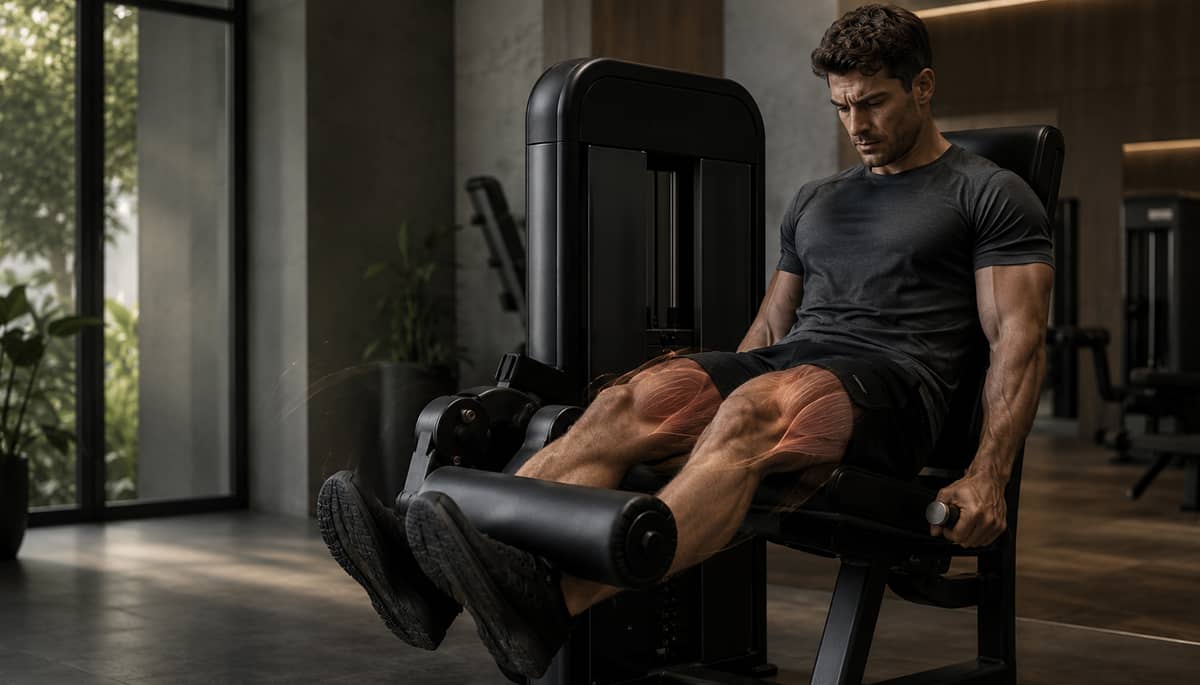
Table of contents
Why exercise order matters
In resistance training, most attention usually goes to load, number of sets, repetitions, movement tempo, and rest intervals. Less attention is often paid to the order in which exercises are performed and how this order affects accumulating fatigue.
This study suggests that even when the number of sets, repetitions, and rest periods are the same, the structure of the session may change how muscles respond. The most interesting comparison is between two approaches: alternating resistance training, where exercises for opposing muscle groups are performed in an alternating sequence, and successive resistance training, where all sets of one exercise are completed before moving to the next one.
In practice, this means that not only “how much” and “how hard” someone trains may matter, but also how the exercises are arranged within a session.
Study details
- Publication title: Effects of alternative and successive resistance training methods on the muscle fatigue of concentric and eccentric contractions in healthy male individuals.
- Authors: Masafumi Kadota, Masatoshi Nakamura, Riku Yoshida, Kosuke Takeuchi.
- Date / year of publication: 2025.
- Journal / venue: Frontiers in Sports and Active Living; peer-reviewed scientific journal.
- Identifiers: DOI:
10.3389/fspor.2025.1640202; PMID:41311623. - Links: PubMed, full text in Frontiers.
- Study type and design: randomized repeated-measures crossover design.
- Population and sample: 17 healthy, untrained men; mean age 20.5 years.
- Intervention or exposure: participants performed two resistance training protocols on an isokinetic dynamometer: alternating resistance training and successive resistance training.
- Main outcome / endpoint: changes in muscle strength before and after training, as well as training volume during concentric and eccentric contractions.
- Funding and conflicts of interest: the study was supported by JSPS KAKENHI, grant number
22K11595; the authors declared no commercial or financial conflicts of interest. - Journal context: Frontiers in Sports and Active Living publishes scientific work related to sport, physical activity, and exercise physiology.
This was a short-term laboratory study, so its findings are best interpreted as insight into fatigue mechanics rather than a ready-made template for an entire training program.
What exactly was compared
The researchers compared two ways of performing knee flexion and knee extension exercises.
Alternating resistance training
In this protocol, participants performed the exercises alternately:
- knee flexion,
- rest,
- knee extension,
- rest,
- knee flexion again,
- and so on.
This meant that a given muscle group effectively had more time for partial recovery, because it could rest while the opposing muscle group was working.
Successive resistance training
In this protocol, participants first completed all sets of one exercise and only then moved to the next one:
- three sets of knee flexion,
- followed by three sets of knee extension.
Formally, the rest intervals between sets were the same, but the actual recovery time for a given muscle group was shorter than in the alternating protocol.
Key findings
The most interesting findings concerned fatigue in the quadriceps muscle and total training volume.
Eccentric contractions were less prone to fatigue
In the study, eccentric contractions showed lower fatigability than concentric contractions. In other words, the controlled lowering or lengthening phase under load was more resistant to declines in strength and work volume than the active muscle-shortening phase.
This fits with previous knowledge about eccentric work: this type of contraction is often associated with lower energetic cost and a greater ability to produce force.
Alternating training helped maintain higher work volume
For knee extension, alternating resistance training was associated with a smaller decline in training volume than successive resistance training. Total work volume was also higher in the alternating protocol.
This suggests that alternating exercises for opposing muscle groups may help maintain the quality of work across sets.
The difference was more about fatigue during training than strength after training
The researchers did not observe significant differences between the two methods in pre-to-post changes in muscle strength. The differences appeared mainly in how work volume changed across sets.
This distinction matters: a training method may not clearly change a simple “before vs after” strength measure, but it may still affect how much high-quality work can be performed during the session.
How to interpret these findings in practice
For people doing resistance training, the simplest takeaway is this: exercise order can be a tool for managing fatigue.
This does not mean that every workout should automatically be arranged in an alternating format. It means that, in some situations, alternating exercises may be useful, especially when the goal is to maintain training volume and movement quality.
Practical examples may include:
- alternating a quad-dominant exercise with a hamstring-dominant exercise,
- alternating a pushing movement with a pulling movement,
- pairing a knee-dominant movement with a hip-dominant movement,
- separating heavier sets with an exercise for another muscle group instead of completing all sets of one movement in a row.
This structure may be especially helpful when the goal is to perform more total work without excessive local fatigue in one muscle group.
At the same time, the study used a simple laboratory setup, untrained young men, and two exercises performed on an isokinetic dynamometer. This is not proof that the same effect will appear in every training plan, in every person, and with every type of exercise.
Limitations
The findings are interesting, but several limitations matter:
- the study included only 17 participants,
- all participants were healthy, untrained young men,
- the study assessed a short-term training response, not long-term gains in strength or muscle mass,
- the exercises were performed on an isokinetic dynamometer, which differs from typical gym-based resistance training,
- the study focused on knee flexion and knee extension, so the findings cannot be automatically generalized to all exercises and muscle groups.
The most reasonable interpretation is cautious: alternating resistance training may help reduce local fatigue and maintain higher training volume, but more research is needed to assess its long-term effects on strength, hypertrophy, and recovery.
Sources
- Effects of alternative and successive resistance training methods on the muscle fatigue of concentric and eccentric contractions in healthy male individuals — PubMed
- Effects of alternative and successive resistance training methods on the muscle fatigue of concentric and eccentric contractions in healthy male individuals — Frontiers in Sports and Active Living