Lifespan
— years
- Potential trajectory
- —
- Potential gain
- —
- Likely statistical range
- —
Answer a short questionnaire to estimate your lifespan, healthspan and peakspan trajectories based on WHO population data and lifestyle factors. Runs locally in your browser — we don't store your data.
Localhost dev tools
Jump to steps or fill the questionnaire with random / biased profiles to stress-test results.
Analyzing your responses…
Create an account or log in to view your personalized lifespan, healthspan and peakspan report.
Registration is completely free.
Safe to continue — your report stays in this browser until you come back. You will not need to fill the questionnaire again.
Your answers stay only in this browser and are not sent to our servers.
Check your inbox and follow the verification link. Return to this page after confirming your email to see your saved report.
Your report is safely waiting in this browser — you will not need to complete the questionnaire again.
Fill in the questionnaire and click Calculate.
— years
— years
— years
Performance test results needed
Add results from a Performance Test battery to calculate your Peakspan.
Your Lifespan and Healthspan answers are already saved. This only adds a few extra questions — you will not start from scratch.
Longevity trajectory
Healthy years
High-performance years
Domain scores
Factor impact
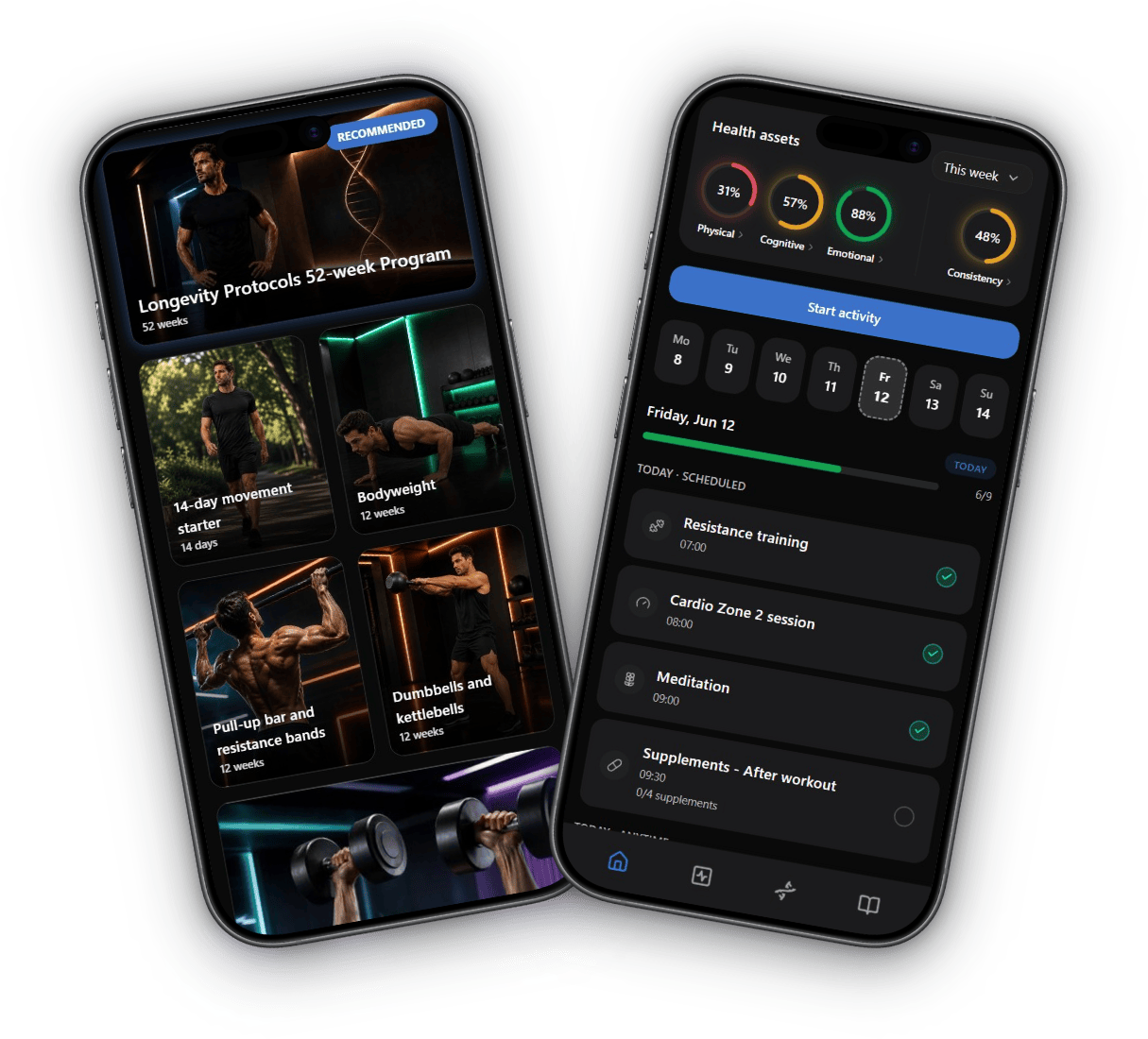
Longevity Protocols App
Longevity Clock shows where you stand. The Longevity Protocols app helps you act on it — with a personalized longevity plan for training, habits, supplements, diagnostics, and daily consistency.
The value of healthy years
Healthspan is the part of life in which mobility, energy and independence support the experiences that matter to you. The goal is not only to live longer, but to remain capable for longer.
Estimated healthy years
— years
Potential healthy-year gain
—
More independent mornings
—
Current estimate, achievable improvement and remaining lifespan.
The longevity paradox
Modern medicine often extends lifespan faster than healthspan. The result can be more years at the end of life spent managing disease, dependency and lost capacity — not more years of freedom. The goal is not to stretch the final chapter. The goal is to lengthen the chapter where life still feels like life.
Estimated lifespan
— years
Estimated healthspan
— years
Years after healthspan
— years
—
—
Add life to years — compress the years of decline.
Illustrative comparison based on your model estimates. It describes structure of healthy vs later-life years, not a medical diagnosis.
A decline does not make every activity impossible, but it can make everyday freedom harder to maintain or increase the need for support.
With function protected
When function declines
The value of high-performance years
Peakspan represents the window in which physical capacity, cognition and recovery best support ambitious work, demanding travel and challenging experiences.
Estimated peak years
— years
Potential peak-year gain
—
More high-capacity days
—
Current high-performance window and realistic improvement potential.
Lower scores indicate capacities that may be worth protecting next. Examples describe how reduced capacity can affect demanding activities, not guaranteed future outcomes.
Supports hiking, cycling, stairs and long active days.
Supports lifting luggage, carrying groceries and physical work.
Supports floor movement, stairs and getting in and out of vehicles.
Supports uneven terrain, confident movement and fall resilience.
Supports sustained pace across consecutive demanding days.
Supports learning, complex work, planning and decisions.
Future medicine access
Your task is not to predict the future of medicine. It is to keep your body and brain in good enough condition for long enough to benefit from breakthroughs that are still ahead — AI-accelerated discovery, regenerative therapies and ageing research.
Healthy years remaining
— years
Optimized remaining
—
Horizon Reach Score
— / 100
—
Which breakthrough horizons still fall inside your healthy years — today vs after optimization.
Near-term · ~10y
—
Mid-term · ~20y
—
Long-shot · ~30y
—
If you stay on your current path
—
If you capture your potential
—
The idea of “escape velocity from death” describes a future where medical progress can extend healthy life faster than ageing takes it away. Whether humanity reaches that point or not, one asymmetric advantage already exists:
—
This is an illustrative strategic model based on your questionnaire estimate and simplified progress horizons. It is not a prediction of medical timelines or individual outcomes.
No major improvement levers detected for this profile — your inputs may already reflect a strong trajectory.
Important notes
These results are educational simulations. Use them as direction for lifestyle optimization — not as medical advice, diagnosis or prognosis.
Lifespan
Motivational simulation based on population statistics and lifestyle research. Not a medical prognosis. Does not predict date of death.
Healthspan
Healthspan estimates are motivational simulations based on population HALE data and lifestyle research. Not a medical prognosis or diagnosis.
Peakspan
Peakspan is an educational and motivational estimate created by this application. It is not a validated medical measure, diagnosis or prediction of future disability.
ROI ranking
ROI ranks relative upside from the simulation, not guaranteed medical outcomes. Overlapping domains (e.g. activity) can contribute to more than one column.
Evidence-informed platform
Lifespan, healthspan and peakspan models combine your questionnaire answers with large-scale population health statistics and epidemiological research. Baselines draw on WHO Global Health Estimates and Healthy Life Expectancy (HALE) for 60 countries; performance norms and lifestyle adjustments are calibrated using nationally representative surveys and peer-reviewed cohort studies — together reflecting vital statistics and health examinations covering more than 150 million individuals worldwide, plus billions of person-years of population-level mortality data.
This tool applies published population patterns to your individual inputs. It does not access or store your personal health records.