Supplement schedules
Plan continuous, temporary, and cyclical supplements—and see at a glance what you take now, later, or on break.

Table of contents
Why not every supplement should run on autopilot
Supplementation often starts with a clear reason—a deficiency, a stressful period, poor sleep, an unfavorable lipid profile, gut symptoms, or heavier training. After a few weeks, however, many products become a fixed part of the day, like morning coffee. The problem is that not every supplement is meant for indefinite daily use.
This does not mean supplements are inherently harmful. In many situations they can be useful. The point is that some behave more like temporary interventions than foundational nutrients. Zinc, selenium, ashwagandha, berberine, bergamot, probiotics, and high-dose vitamin C often make the most sense when they address a specific goal, are used at an appropriate dose, and are reassessed after a defined period.
A practical mental model is: cycle → measure or observe → decide. Instead of assuming something should be taken all year, it helps to define the goal, duration, and stopping criteria. That turns supplementation from a growing list of capsules into an intentional protocol.
It also helps to distinguish three broad groups:
- Foundational nutrients — fill a dietary gap or support a repeated physiological need (for example vitamin D when levels are low, creatine for training, omega-3 when fatty fish intake is low, magnesium when intake or demand is higher). These often support longer-term use when there is a clear reason and periodic review.
- Targeted interventions — address a specific issue such as lipids, glucose, stress, sleep, or gut symptoms. They usually need a goal, a duration, and a reassessment point (often roughly 6–12 weeks).
- Substances with a narrower safety window — may disturb the balance of other nutrients or carry more risk with long-term high-dose use (for example high-dose zinc affecting copper status, or selenium where excess can be problematic).
The second and third groups are the ones that most often benefit from a cyclical or time-limited approach. Before starting or continuing, it is worth asking: What problem am I solving? What marker or symptom will tell me if this worked? What happens if I stop?
Note: This documentation is not medical advice. If you have a medical condition, take medication, have abnormal lab results, are pregnant, or have liver, kidney, or immune issues, supplementation decisions should be discussed with a qualified professional.
Want to go deeper? The full rationale—with examples, supplement-by-supplement guidance, and common mistakes—is in our article Should you cycle supplements?.
What supplement schedules do
Supplement schedules in Longevity Protocols help you organize what you take, when in the day, and for how long—including planned breaks. Instead of tracking cycles in a notebook or spreadsheet, you define the schedule once and the app handles status, daily visibility, and change reminders.
The feature combines three elements:
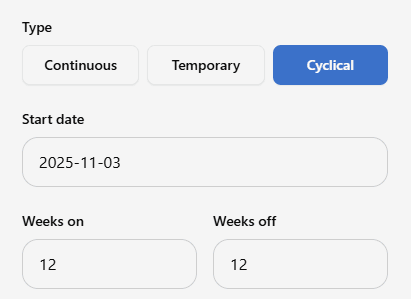
- Schedule types: supplements can be continuous, temporary (start and end date), or cyclical (weeks on / weeks off).
- Clear status: each supplement is labeled current, future, on break, or past so you always know where it sits in the plan.
- Daily integration: active supplements appear on your Home checklist by time of day, alongside habits and other protocol actions.
Use supplement schedules when you run more than a few products, when some are long-term foundations and others are short interventions, or when you want cyclical breaks (for example 8 weeks on, 4 weeks off) without mental overhead.
Problems that supplement schedules help solve
Did you know that some supplements only make sense for a limited time—or with planned breaks?
Many people know what to take but lose track of when a course should end, when a break should start, or when to restart. With a dozen capsules, it is easy to keep taking zinc “for immunity” long after the original reason passed, or to forget that ashwagandha was only meant for a high-stress quarter. The result is supplementation that feels like a ritual rather than a decision system.
Supplement schedules help address this planning gap. They turn “I should cycle this” into a defined schedule the app can track, filter, and remind you about.
This is especially useful when the need is not “What should I take?” but “How do I run on / off periods without chaos?” Supplement schedules can help by:
- Separating foundations from interventions: keep vitamin D or creatine continuous while running berberine or a probiotic as a timed course.
- Making cycles explicit: set weeks on and weeks off instead of guessing when the break started.
- Showing status at a glance: filter current, future, break, and past so you see what is active today versus paused or finished.
- Reducing missed transitions: reminders when a cycle ends, a break begins, or supplementation resumes—so reassessment moments are harder to skip.
Use supplement schedules when you follow cyclical protocols, seasonal interventions, or any stack where some products are “always on” and others are “for now.”
How supplement schedules work
The flow from setup to daily use:
- Add a supplement from the library or create your own entry with name, dose, and section (time of day).
- Choose a schedule type: continuous, temporary, or cyclical—and set dates or on/off weeks.
- Review status on the Supplementation screen (current, future, break, past).
- Take daily from the Home checklist when the supplement is in an active period.
- Get notified when a course or cycle phase is about to change, then reassess.
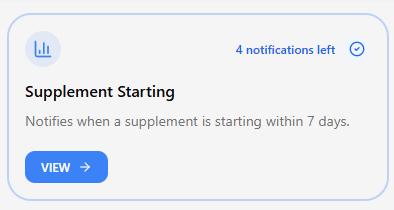
This is more than a static list. The app calculates whether each supplement is active today based on type, dates, and cycle rules—so breaks and future starts are reflected automatically.
How to open supplement schedules
You manage schedules from the Supplementation area:
- Tap the Protocol tab in the bottom navigation.
- Open the Supplementation tile from the protocol grid.
- Use Add supplement (library) or tap an existing supplement to edit its schedule.
From Home, you can also open a supplement from the daily checklist to view or edit details for that day.
Choose continuous, temporary, or cyclical
When adding or editing a supplement, select a schedule type in the supplement form.
Continuous
For supplements you intend to use ongoing, when there is a stable reason and good tolerance—for example creatine, magnesium, or vitamin D aligned with monitored levels. No end date is required; the supplement stays current until you change or archive it.
Temporary
For a fixed intervention with a clear start and end—for example a 8-week probiotic trial or a short course during travel or illness. Set start date and end date. After the end date, status moves to past.
Cyclical
For weeks on / weeks off—for example 12 weeks on and 12 weeks off, or 8 on / 4 off. Set:
- Start date (when the first “on” period begins),
- Weeks on,
- Weeks off.
The app alternates active and break periods from that anchor. This fits interventions you want to reassess periodically (as discussed in the cycling supplements article).
Tip: When testing whether a supplement helps, avoid starting several new cyclical products on the same day—otherwise it is harder to know what changed.
View status and filter your stack
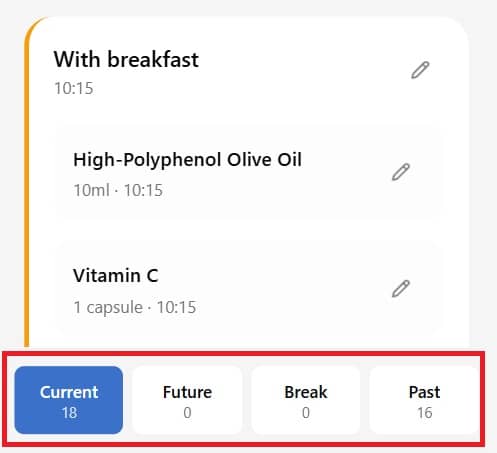
On the Supplementation screen, use the filter pills:
| Filter | Meaning |
|---|---|
| Current | Active today—shown in time-of-day sections and on Home. |
| Future | Scheduled to start later (start date in the future). |
| Break | Cyclical supplement in an off week period. |
| Past | Finished temporary course or inactive supplement. |
The Current tab groups supplements by sections (for example with breakfast, before bed). Other tabs show a flat list—useful for reviewing what is paused or coming next.
Tap a supplement for details; use the edit control to adjust dose, dates, or cycle length.
An upcoming changes area on the same screen highlights supplements whose course or cycle phase is ending or resuming soon (for example “Break starting in 3 days” or “Resuming today”).
Reminders for cycle and course changes
Longevity Protocols can notify you when supplement status is about to change—for example:
- a temporary course ending,
- a cyclical “on” period ending (break starting),
- a break ending (supplementation resuming).
Check Notifications in the app (and email preferences if enabled) so longer cycles are not lost in daily noise. Reminders support the reassess step: when a phase ends, review markers, symptoms, or how you felt during the cycle before automatically restarting.
Rules and FAQ
What is the difference between temporary and cyclical?
Temporary runs once from start date to end date, then stops. Cyclical repeats on and off periods (in weeks) from the start date until you change or deactivate the supplement.
Do supplements on break appear on Home?
No—they are not due during the off period. Switch to the Break filter on the Supplementation screen to review them.
Can I mix continuous and cyclical supplements?
Yes. Many protocols keep foundations continuous while cycling targeted interventions.
How are weeks on/off calculated?
From the start date, the app counts full cycle lengths (on weeks + off weeks) and determines whether today falls in an active or break segment.
Can I add supplements from a library?
Yes. Tap Add supplement on the Supplementation screen to browse the Supplement library, then set schedule type and dose before saving.
Is this medical advice?
No. The app helps you organize and track schedules you choose. Decisions about what to take, dose, and duration belong with you and your clinician when appropriate.